Rising inflation may push real rates lower, setting the stage for gold’s next rally

(Kitco News) – The gold market continues to struggle as prices remain firmly below their 200-day moving average. The selling pressure has been driven by rising inflation fears, but one analyst says that this threat could also be gold’s greatest long-term strength.Gold prices broke through critical support Friday after the Bureau of Labor Statistics announced that 172,000 jobs were created in May, significantly more than expected. Resilient strength in the labor market is prompting markets to price in a potential rate hike before the end of the year.According to the CME FedWatch Tool, markets see a nearly 50/50 chance of a rate hike as early as October. The hawkish tilt represents a significant shift from only a month ago, when markets were still pricing in a rate cut.Although gold has sold off on expectations that higher interest rates will raise the opportunity cost of holding a non-yielding asset, Nitesh Shah, Head of Commodities and Macroeconomic Research at WisdomTree, said that markets may be getting ahead of themselves.He explained that he sees a real possibility that inflation pressures could outpace the Federal Reserve’s ability to respond, pushing real interest rates deeper into negative territory and reinforcing investor demand for hard monetary assets.Although markets continue to debate the policy direction of newly appointed Federal Reserve Chair Kevin Warsh, Shah said the more important story for gold is not where nominal interest rates move, but what happens to inflation.”There’s a lot of potential for real rates to go down, especially if the Fed is holding still and inflation is rising,” Shah said.Warsh has previously expressed support for lower interest rates while simultaneously shrinking the Fed’s balance sheet. However, Shah argued that elevated inflation leaves policymakers with little room to aggressively cut rates without risking their credibility.”Right now, the data doesn’t really allow for rate cuts because inflation is rising,” he said. “Cutting rates in this environment would be disastrous from a credibility standpoint.”Even if the Fed keeps nominal rates unchanged, Shah noted that accelerating inflation would effectively reduce real interest rates — one of the most important factors impacting gold prices.Inflation Risks Remain UnderestimatedAccording to Shah, investors may still be underestimating the potential for inflation surprises in the months ahead.One area of concern is energy markets. He noted that global oil inventories have been steadily declining, creating the potential for a nonlinear move higher in prices if supplies become increasingly constrained.”We started this period with huge inventories of oil, and that inventory is wearing down rapidly,” he said. “The more you pull down inventories, the greater the marginal impact on oil prices.”Higher energy prices could continue to filter through broader inflation measures at a time when inflation is already moving above the Federal Reserve’s target.While technological advances such as artificial intelligence could eventually improve productivity and help contain service-sector inflation, Shah argued that the outlook for goods inflation remains more problematic.”I think we’re stuck with high prices,” he said.He added that this scenario would continue to erode real yields, reducing the opportunity cost of holding non-yielding assets such as gold.Beyond inflation, Shah said the growing possibility of slower economic growth could create an additional catalyst for gold.Any resulting economic slowdown would likely reinforce gold’s role as a defensive asset.”If you do start seeing economic deceleration, that’s another reason for gold prices to rally,” Shah said. “Gold tends to do well in recessionary scenarios. It is a very strong defensive asset.”Shah also pointed to growing concerns surrounding government debt sustainability as another structural pillar supporting gold prices.Interest payments on U.S. government debt are approaching levels comparable to military spending, raising questions about the long-term sustainability of fiscal policy.”Gold prices are as elevated as they are right now because markets are worried about the sustainability of debt,” he said.Although Warsh has indicated a desire to shrink the Federal Reserve’s balance sheet and reduce the government’s dependence on monetary support, Shah remains skeptical that meaningful balance sheet reduction will be politically or economically achievable.Slower economic growth and rising fiscal pressures could ultimately force policymakers back toward easier monetary policy, further strengthening gold’s investment case.With inflation risks rising, real rates facing downward pressure, recession concerns mounting, and central-bank buying remaining robust, Shah believes gold’s recent correction may ultimately prove temporary.”I think we’re sitting on a bargain in gold right now,” he said.Shah added that recovering the roughly $1,000 decline from recent highs within the next year appears achievable if inflation continues to surprise to the upside and investors increasingly seek protection in hard monetary assets.
China increases gold reserves by 9.95 tonnes in May for 19th straight month of purchases

(Kitco News) – The People’s Bank of China (PBoC) increased its gold reserves by nearly 10 tonnes last month, its 19th consecutive month of bullion purchases, according to the latest government data.The State Administration of Foreign Exchange (SAFE) announced on Sunday that China’s official gold reserves rose by 320,000 troy ounces or 9.95 tonnes in May to a total of 74.96 million troy ounces or 2331.52 tonnes.China’s total foreign exchange reserves rose to $3.4422 trillion at the end of May, increasing by $31.7 billion or 0.93% from April. This is the highest level for China’s FX reserves since November 2015, and they have remained above $3.3 trillion for the past 10 months.SAFE attributed the growth of reserves to a number of factors, including a firmer U.S. Dollar Index and rising global asset prices, adding that China’s sound economic momentum has underpinned the stability of its reserves.Experts have noted that China’s rising foreign exchange reserves are closely linked to the country’s export performance. China’s total foreign trade in the first four months of 2026 rose to $2.39 trillion, an increase of 14.9% year-on-year, with exports rising by 11.3% percent to $1.37 trillion and imports rising 20% percent to $1.01 trillion, according to the latest data from China’s General Administration of Customs.Meanwhile, China’s domestic gold market has shown definite signs of cooling in recent weeks. “Amid heightened market uncertainty, gold ETFs have seen an overall reduction in assets under management, with several funds experiencing significant net outflows,” noted a report from Gelonghui Finance. “As of June 3, 14 gold ETFs recorded combined net outflows exceeding RMB 10 billion [$1.48 billion] over the past month.”“The previously widely accepted investment view of ‘buying on dips amid falling gold prices’ has started to face divergence under current volatile market conditions,” they added.Chinese gold equities listed in Hong Kong also declined sharply in a move characterized as ‘unusual.’“Hong Kong-listed gold stocks broadly declined, with China National Gold International Resources and Jihai Gold down 3.6%, Zijin Mining falling 3.5%, Shandong Gold and Zhaojin Mining dropping nearly 3%, Zijin Gold International declining 2.4%, and Chifeng Gold, Lingbao Gold, China Silver Group, Zhufeng Gold, and Tongguan Gold also following lower,” the report noted.China’s physical gold market has also cooled substantially from the white-hot demand seen at the start of the year when international and domestic gold prices were setting new all-time records on a near-daily basis.The latest numbers from the Shanghai Gold Exchange (SGE) showed that gold withdrawals in May totaled only 63.5 tonnes – the lowest level since February of 2020 during the first wave of the COVID-19 outbreak, and around half of what they were in March of this year.Industry professionals told Gelonghui Finance that “while short-term gold price volatility may persist, the core rationale supporting gold’s strategic allocation value remains intact over the medium to long term.”
Australia gold output down slightly as prices vary widely

Australian gold production fell almost 3% to 75 tonnes in this year’s first quarter compared to the previous period due to rain and bushfires, while gold price highs kept the…
Former U.S. Geological Survey Director and NASA Astronaut James Reilly joins TerraSpace as Senior Advisor
Former NASA astronaut, geologist, and USGS Director joins TerraSpace to advise on critical minerals, exploration technology, and space resources strategy
AUSTIN, TX, UNITED STATES, June 8, 2026 /EINPresswire.com/ — TerraSpace, a company developing …
Ottawa’s ‘AI for All’ Brings New Support for Canadian Trades and Manufacturers Adopting AI
Canada’s “AI for All” commits to helping small businesses adopt AI. WebMax Canada offers trades, manufacturing and service businesses a free readiness roadmap.
VICTORIA, BRITISH COLUMBIA, CANADA, June 8, 2026 /EINPresswire.com/ — Canada…
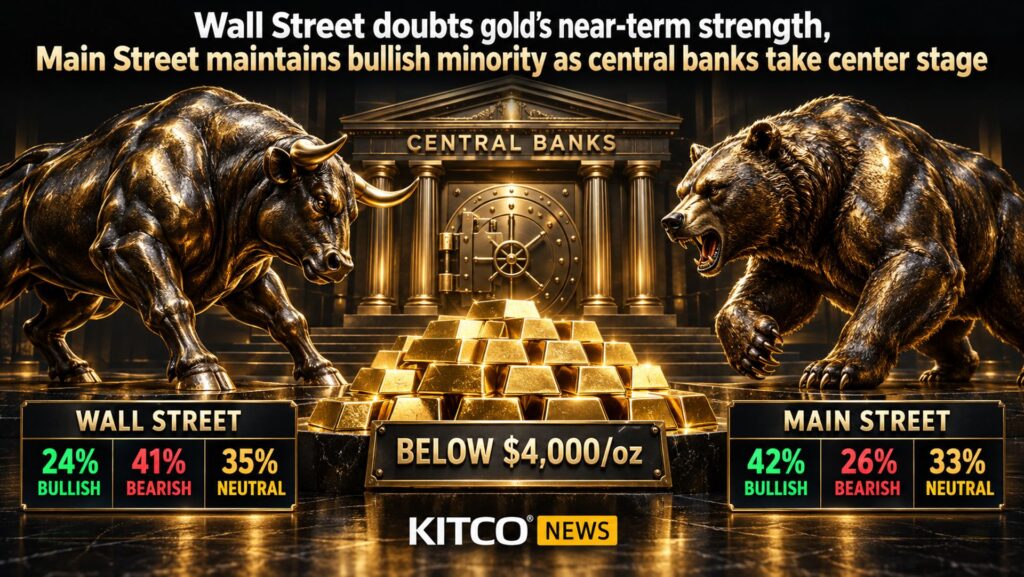
Wall Street brimming with bears after gold’s breakdown, Main Street pessimism persists as inflation data takes center stage

(Kitco News) – Gold prices saw another volatile week as persistent Middle East uncertainty offered only limited safe-haven support, while stronger U.S. labor data, rising Treasury yields, and renewed Fed rate-hike concerns drove the yellow metal sharply lower on Friday.Spot gold kicked off the week trading at $4,539.42 per ounce on Sunday evening, and the yellow metal briefly pushed higher as traders reacted to fresh uncertainty around Iran and the Strait of Hormuz. But the rally quickly stalled after reports that Tehran was stepping back from talks, sending oil prices, Treasury yields, and the U.S. dollar higher, with gold ultimately setting its weekly high of $4,545.55 per ounce on Monday before sellers took control.Gold prices attempted to stabilize Tuesday, helped by cautious optimism around a partial Israel-Hezbollah ceasefire, but the recovery faded below $4,550 after April JOLTS data showed job openings jumping to 7.6 million, reinforcing expectations that the Fed would have little reason to ease policy. The pressure continued Wednesday as ADP pointed to steady labor-market conditions, pushing policy-sensitive yields higher and keeping gold on the defensive.The metal found some relief Thursday as Treasury yields and the dollar eased on renewed hopes for a broader regional de-escalation and progress toward reopening the Strait of Hormuz. But Friday’s stronger-than-expected May jobs report reversed the move, with U.S. payrolls rising by 172,000 and rate-hike fears returning in force. Gold broke decisively lower in the wake of the payrolls data, and set its weekly low at $4,311.93 per ounce on Friday afternoon as the selloff accelerated, with the yellow metal seeing only a slight bump off the low heading into the close.The latest Kitco News Weekly Gold Survey showed Wall Street overwhelmingly bearish on gold’s near-term prospects, while Main Street grew more pessimistic after gold’s week of weakness.“Gold looks heavy and the stronger-than-expected US jobs growth and the backing up in yields pushed the yellow metal back below the 200-day moving average (~$4428),” noted Marc Chandler, managing director at Bannockburn Global Forex. “It has not settled below it since Nov 2023. May’s low near $4367 is the next obvious technical level of interest.”“Unchanged,” said Adrian Day, president of Adrian Day Asset Management. “Gold will stay in a trading range until the Iran hostilities end. The conflict boosts the dollar and, by causing the oil price to be high, raises concerns about higher interest rates, both bad for gold.”“Up,” said Rich Checkan, president and COO of Asset Strategies International. “The sell-off in gold is overdone. The real return on investment for holding term deposits at a bank is negative… with interest rates at 3.5% and inflation at 3.8%… and climbing. We are a long way away from the ‘higher’ interest rates necessary to make owning gold less attractive.”Eugenia Mykuliak, Founder & Executive Director of B2PRIME Group, said gold prices are at one of their most interesting points over the past year.“This is the second time the price has tested the 200-day average, and I think it can be the level that often determines the long-term trend,” she said. “However, at first glance, the background can look alarming. The thing is, in May, global gold ETFs lost about $2 billion, and investors continue to take profits and partially withdraw into US bonds.”There is a nuance to the picture, however. “As long as speculative capital is coming out of gold, central banks continue to buy it,” Mykuliak noted. “In April, the world’s central banks returned to net purchases, adding 17 tons to reserves after the March pause. Moreover, gold continues to strengthen its position as a reserve asset and gradually takes away the share of US government bonds in international reserves (especially against investors’ turn to ultra-short bonds).”Mykuliak said she doesn’t believe gold’s current weakness as the beginning of a bear market. “Instead, I would say that we are witnessing a so-called clash: short-term sales by investors vs. long-term strategic demand from states,” she said. “So, if the 200-day average level holds, gold may well receive an impulse for a new wave of growth. Otherwise, the correction will be delayed, but I believe the fundamental history of gold remains strong, as in any case, it’s an undeniable safe-haven.”Kevin Grady, president of Phoenix Futures and Options, told Kitco News that reports of the economy’s death have been greatly exaggerated, and gold has further to fall before it bounces.“The numbers are good, and the revisions were up,” Grady said. “Everybody keeps throwing bad stuff at this, ‘Oh, this is gonna be bad, and that’s gonna be bad, and the economy is not doing well.’“It just doesn’t appear to me to be the case, he said. “The economy looks like it’s in better shape.”Grady said there’s been a lot of speculation about the rate path, but Friday’s nonfarm payrolls report lowers the temperature on that talk. “Raising rates, lowering rates, Warsh, how is he going to deal with this? I don’t think that’s an issue for right now,” he said. “I think there’s still some data out there that he has to look at.”As for gold’s selloff in the wake of the payrolls report, Grady said it’s important not to overreact to the price action in either direction when the market is as thin as it is, but the fresh lows could bring an important segment of buyers back into the market.“Gold stalled up there, and there were no fresh buyers coming in,” he said. “The volume has been anemic. Open interest is very low for gold right now. A lot of people just aren’t buying. I think what’s happening now is that gold is up at these levels, and now they’re saying, ‘Who’s the next buyer?’ The reason gold rallied [at the start of the multi-year rally] was because of the central bank buying. I think we have to look and see what that level is, where the central banks are going to come in and buy, because they weren’t doing it up at those higher levels, and that’s why the market’s testing those lows.”But after Friday morning’s definitive break through the 200-day moving average, Grady believes gold will likely return to test the March 23 low of $4,128 before things turn around.“There’s no reason we couldn’t test that level,” he said. “But the lower volumes and lower open interest are a double-edged sword. Slowly, gold has been eroding a tremendous amount of open interest. And with the market higher up like that, the assumption would be that there’s a lot of longs in the market. The active contract is August, and the August contract is 263,000 contracts, which is very low.”Grady said the market is actually thin on both sides, and he doesn’t see any more conviction in Friday’s selloff than he has in the recent moves higher.“I don’t think that you’re seeing a massive amount of longs,” Grady added. “I think you’re seeing some speculative shorting here. The algos read the data and then they’re pushing this thing lower, and I just don’t think there’s a lot of people right now that are stepping in their way. I don’t think this is a mass liquidation. We’ll see on Monday, but I don’t think you’re seeing a mass liquidation of gold.”He said the larger truth is that people have backed away from the market since March. “The market was up there, and then it stalled,” he said. “Whether you’re talking about the upside or downside in any market, when the market stalls like that, it’s waiting for the next buyer to come in. Who’s the next buyer? No one’s coming in. Open interest is diminishing. A lot of the players are starting to back away.”“I think it was inevitable for us to test these lows.”This week, 15 analysts participated in the Kitco News Gold Survey, with Wall Street flipping from three-quarters bullish to three-quarters bearish after gold’s failure to maintain critical support. Only two experts, or 13%, expected to see gold prices gain ground during the week ahead, while 11 others, or 74% of the total, predicted a price decline. The remaining two analysts, representing 13%, expected consolidation during the week ahead.Meanwhile, 49 votes were cast in Kitco’s online poll, with Main Street investors growing more pessimistic after gold’s latest slide. 23 retail traders, or 47%, looked for gold prices to rise next week, while another 18, or 37%, predicted the yellow metal would lose ground. The remaining eight investors, representing 16% of the total, expected gold prices to trend sideways in the coming week.After a week focused squarely on employment, next week will feature several key inflation metrics that could help market participants firm up their increasingly hawkish interest rate expectations.The economic calendar kicks off on Tuesday morning with the release of Existing Home Sales for May. On Wednesday, traders will be watching the U.S. Consumer Price Index, along with the Bank of Canada’s monetary policy decision, with markets priced in for a hold.Then Thursday morning brings the ECB’s monetary policy decision, with traders seeing good odds of a hike this time, followed by the U.S. Producer Price Index and weekly jobless claims.The week’s economic data wraps up Friday morning with the University of Michigan’s Preliminary Consumer Sentiment Survey for June.John Weyer, director of the commercial hedge division at Walsh Trading, told Kitco News that the higher-than-expected payrolls data, combined with the upward revisions to prior months, constitute a positive trend for U.S. employment.“The one concern on the job numbers, 55,000 were local government hires, he noted. “That’s a pretty large number, and you would think that’s one that won’t be sustained. It’s an interesting wrinkle, but with the revisions, all of a sudden, you’re getting an upward trend here.”“The one thing you might have a concern about, also pointed out by others, was the idea that those who sustained unemployment is growing, those who’ve been off work six months longer is continuing to grow. That’ll give you some concern. But overall, anytime you get something better than expected, it’s always good.”Weyer said the reaction in the gold and silver market has more to do with the surprise than anything else, and he thinks Friday’s selloff was somewhat overdone.“When you see gold down $130, if you’ve been around as long as I have, you think ‘Holy cow! Is the world ending?’ That being said, you can see this making sense,” he said. “There’s an issue going on here with Iran and the Strait of Hormuz. But as long as we don’t have active bombings or attacks, it is being dealt with, it’s a known entity, as opposed to an unknown. Markets can handle good news, they can handle bad news, what they don’t like is uncertainty. We got a little bit of certainty there with the current status [of the ceasefire]. Now if that changes, I would expect the metals to get a lot of this back. I won’t say it’s not a concern, but we’ve learned how to deal with it.”“Now you’re getting some positive sustained economic data,” he added. “It gives you a reason to say, ‘Hey, metals are not the safe haven play.’”Weyer said that interest rate expectations adjusted swiftly in the wake of the payrolls report, and whatever easing bias remained in the market has dissipated.“What I learned being in the trade business, is that I’ll go where the people have money on the line,” he said. “Right now [Treasury futures] are down across the board, which means you’re definitely not expecting any cuts anytime soon. You wonder how far out they’ll go, or how close they’ll come, where they say, ‘We have to consider raising rates is on the table.’ But definitely the idea that cut… It’s hard justifying any rate cut right now. I think it’s just off the table for a while.”As for the price action, Weyer views this as a near-term move, and he expects the market will get much of it back in short order.“There’s a whole lot of longs here, meaning people are buying gold because they were too late,” he said. “You’re going to see it hold for a bit here, but you’re really going to need, I think, more sustained data like we got today” for a sustained trend lower.Alex Kuptsikevich, senior market analyst at FxPro, expects gold prices to decline once again next week.“Gold has once again tested the 200-day moving average, from which the price rebounded last week and in March,” he wrote. “However, the increasingly frequent tests of this long-standing support level signal a further shift in global sentiment towards gold. Fundamentally, gold broke through in January and March, confirming a trend reversal, but we are now merely seeing a shift in strategy to ‘sell the growth.’”“Technically, at the time of writing ($4,380), gold has slipped below the 200-day moving average and is testing last week’s lows and the March support zone, having returned to October’s peak,” Kuptsikevich noted. “We anticipate a further decline in price, with our next area of interest near $4,250, where the 50-week moving average lies. There could be another local shake-out there, comparable to what we have seen over the past two weeks.”Michael Moor, founder of Moor Analytics, expects to see gold prices lose further ground next week.“LOWER unless we take out lower timeframe formation mentioned below,” he wrote. “In a Higher time frame: I cautioned on 8/16/18 the break above $1,183.0 warned of renewed strength. We have seen $4,443.1. This is ON HOLD. We held exhaustion at 56192 with a 56268 high and rolled over $1,526.8. This is ON HOLD. On a medium timeframe basis: The trade below 52554 (+15 tics per/hour) projects this down $220 minimum, $740 (+) maximum—we attained $1,155.4. The trade back below 52036 (+13 per/hour) has brought in $1,103.6 of pressure. The trade back below 51606 (+13 per/hour) has brought in $1,060.6 of pressure. The trade below 48530 (+4 tics per/hour) has brought in $753.0 of pressure. These are ON HOLD. We held exhaustion at 40956 with a 41000 low and have rallied $817.7. The trade above 41814 has brought in $736.3 of strength. The trade above 43642 has brought in $553.5 of strength. These roll into (Q) and are OFF HOLD.”“On a lower timeframe basis: We held exhaustion with a 49177 high and rolled over $554.2,” Moor said. “The break below 48185 projected this down $185 (+)—we attained $455.0. The trade below 47923 projected this down $205 (+)—we attained $428.8. The break below 47420 brought in $378.5 of pressure. On 5/15 we left a medium bearish reversal—we have come off $189.7 from 45532. Decent trade below 44780 (+5 tics per/hour) will warn of pressure, but will stop short of suggesting leaning against this as a short; but if we break below decently and back above decently, look for decent short covering.”At the time of writing, spot gold last traded at $4,327.88 per ounce for a loss of 4.27% on the week and 3.29% on the day.
What’s next for gold after the 200-day moving average breaks?

(Kitco News) – Gold and silver investors aren’t heading into the weekend with much to feel good about.The precious metals market was hit with a wave of selling pressure as prices broke below their 200-day moving average, a critical support level analysts have been watching closely.In the short term, the risks are undeniable. Momentum has clearly shifted against gold, and it would not be surprising to see additional weakness as traders continue to reduce exposure. It’s even too early to start talking about buying the dip.Market expectations that the Federal Reserve will have to take a hawkish stance to fight inflation have pushed bond yields higher and strengthened the U.S. dollar. Higher interest rates raise the opportunity cost of holding a non-yielding asset like gold, while a stronger U.S. dollar creates another headwind for precious metals.Sharp moves like this can feel decisive in the moment, but they don’t necessarily change the bigger picture. Gold has been supported for years by deeper, more persistent forces, and those haven’t gone away.Despite the chart damage, analysts remain confident that this selloff will prove to be a temporary correction. Many have even said that a year from now, they see prices back above $5,000. Several of the forces that have supported gold over the past few years remain firmly in place and, in some cases, they are becoming even stronger.This week, Kitco News attended the Sohn Montreal conference, and there was a clear message for investors: the global economy will remain fractured for the foreseeable future. The era of globalization, built on efficiency and lowest-cost production, is giving way to a world increasingly focused on resilience, security, and strategic resource control. Hudson Bay Capital CEO Sander Gerber explained at the conference that governments and corporations are no longer making decisions based solely on economics; they are prioritizing supply-chain security and geopolitical considerations. That shift creates uncertainty and inflationary pressures that traditional financial models will struggle to capture.Gold has always thrived during periods when uncertainty outweighs predictability.Even if inflation cools in the near term, the long-term outlook points toward structurally higher fiscal spending, elevated deficits, and continued pressure on central banks to accommodate government borrowing. Hard assets like gold and silver remain among the few effective hedges against this scenario.The current selloff is a reminder that bull markets rarely move in a straight line. Gold may face further downside in the weeks ahead as traders position themselves for potentially higher interest rates. However, for investors willing to look beyond the next quarter, the fundamental case for owning gold remains intact.The chart may look broken today. The long-term outlook remains solid.Despite the disappointing start to the month, I hope you have a restful weekend.
Mexican silver miner Sinda files to go public in USmining.com
The company intends to list its shares on the NYSE under the ticker symbol
B2i Digital Named Official Marketing Partner of 121 Mining Investment New York
A two-day conference brings more than 70 mining companies face to face with North American investors, June 15-16, 2026
NEW YORK, NY, UNITED STATES, June 5, 2026 /EINPresswire.com/ — B2i Digital, Inc. has joined 121 Mining Investment New York as its …
Gold price see solid selling pressure as U.S. economy created 172k jobs in May

(Kitco News) – The gold market is seeing surging selling pressure as the U.S. economy created far more jobs than expected, raising expectations that the Federal Reserve has room to raise interest rates to cool inflation.U.S. nonfarm payrolls rose by 172,000 last month, according to the Bureau of Labor Statistics. The monthly figure significantly exceeded consensus forecasts, with economists expecting job gains of around 85,000.At the same time, April’s employment data saw a significant upward revision, with the government reporting that 179,000 jobs were created that month, compared with the initial estimate of 64,000.Meanwhile, the unemployment rate held steady at 4.3%, in line with consensus forecasts.The gold market has struggled for most of the week, as prices have been unable to hold gains above $4,500. The precious metal dropped sharply in its initial reaction to the better-than-expected labor market data. Spot gold last traded at $4,441.03 an ounce, down 0.77% on the day.