U.S. Treasury’s gold revaluation could restart the ‘debasement trade’ as yield pressures fade
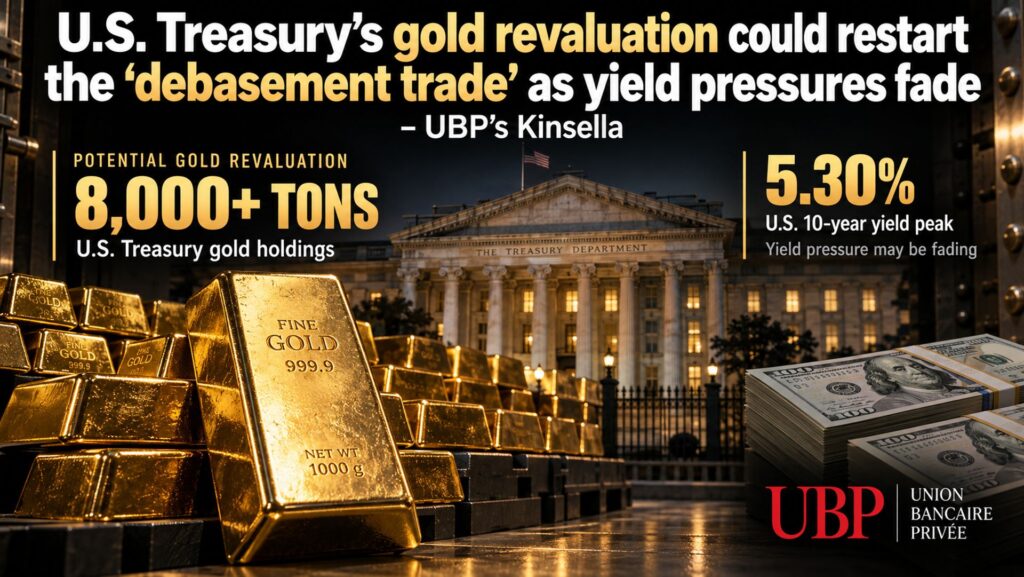
(Kitco News) – Gold has likely seen the worst of its Treasury-yield-driven losses, and once the Iran situation improves and Fed rate hike expectations ease, the Treasury department itself could provide a new tailwind for bullion prices between now and year-end, according to Peter Kinsella, Head of Investment Services for the UK at Swiss private bank UBP.Kinsella noted that gold has traded lower since the Federal Reserve’s 25-basis-point rate hike in September.“The downward move has been rather muted, considering the huge rise in both nominal and real inflation-adjusted interest rates,” he said. “US 10-year yields have risen to highs of 5.30%, and 10-year TIPS yields (a proxy for real interest rate expectations) have risen to levels of just below 3%.”“Normally, we would expect gold to decline materially in such circumstances,” he wrote. “The modest decline suggests that gold–interest rate correlations have continued to wane.”Kinsella pointed out that throughout August and early September, investors continued to increase their exposure to gold, even as treasury yields continued to rise. “Retail investors upped their ETF positions and institutional investors increased net longs in the futures markets,” he said. “These flows are normally highly interest rate sensitive; however, there has been little to no discernible reaction to the large rise in long-end interest rates so far.”“We believe that most of the move in interest rates is now largely complete, giving only limited downside risks for gold and the wider precious metals complex from current levels.”Meanwhile, central banks continue to buy gold, with China’s central bank one of the largest purchasers of bullion once again in 2026. “The pool of central banks adding to their gold holdings this year has narrowed, though this likely reflects elevated prices rather than an unwillingness to increase gold holdings,” Kinsella said. “The World Gold Council’s latest survey showed that a record 45% of central banks expected to raise their gold holdings over the coming year. This means that gold is likely to be well supported by central bank purchases on any significant dip in pricing.”In the short term, UBP expects gold to trade within a tight range. “Markets have moved to price in at least three further 25-bp rate hikes in the coming months, but these expectations appear to be on the high side,” he said. “Most of the rise in US core inflation dynamics reflects one-off factors, giving the US Federal Reserve room to ease up on potential rate hikes once the situation in the Middle East is resolved.”And with rate hikes off the table, bullion prices could actually get a boost from the Treasury in the coming months. “The most pressing upside risk for gold in the coming months would be a potential revaluation of the US Treasury’s gold holdings, which are estimated at just over 8,000 tons,” Kinsella warned. “A revaluation towards current market prices would implicitly devalue the USD relative to gold, thus sending a strong signal to the market and potentially restarting the ‘debasement trade’ which played out in 2025.”Gold prices declined sharply following the release of this morning’s hotter-than-expected CPI report, and they continue to trade near fresh session lows at the time of writingSpot gold last traded at $4,079.42 per ounce for a loss of 1.96% on the daily chart.See live precious metals prices for gold, silver, platinum and palladium — in USD, CAD and 12 more currencies.
Can gold hold $4,000 with an October rate hike still in play?
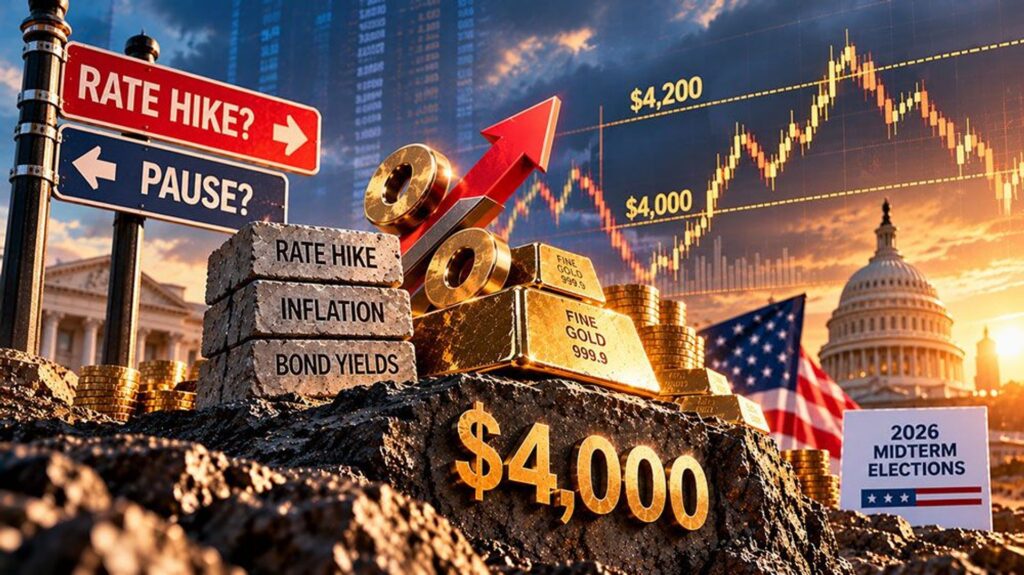
(Kitco News) – Hotter-than-expected consumer prices have put an October rate hike back in play, pushing real bond yields higher and dragging gold prices below a critical near-term support level.However, commodity analysts expect support to continue to hold at $4,000 an ounce, as the Federal Reserve is unlikely to raise interest rates just one week before American voters head to the polls for the 2026 midterm elections.In a note Wednesday, Ryan McKay, Director of Commodity Strategy at TD Securities, noted that gold’s inability to break through resistance at $4,200 has prompted speculative fund managers to liquidate their long positions, while the disappointing inflation numbers have added fuel to the fire.“This systematic selling remains the one corner of the precious metals market that continues to be a notable drag on the yellow metal,” he said.However, he added that other pillars of the gold market remain strong and should continue to provide critical support at $4,000 an ounce, which has become an important technical pivot level.“Beyond near-term hike pricing and systematic selling, macro discretionary positions remain elevated, while ETF inflows and central bank demand also remain strong. These flows have ultimately offered strong support for gold, and we expect these flows will remain robust, especially in the $4,000-4,100/oz region,” he said.Economists and analysts note that the key question for markets is whether inflation is bad enough to force the Federal Reserve to raise interest rates later this month. Traditionally, in an attempt to avoid the appearance of political bias, the Federal Reserve has refrained from changing interest rates immediately before elections.However, with the headline Consumer Price Index rising 3.6% over the 12 months through September, markets are once again shifting their expectations. According to the CME FedWatch Tool, markets see a nearly 44% chance of a rate hike this month. Ahead of the CPI report, markets were pricing in only a 21% chance of a hawkish move.Fixed-income analysts at TD Securities do not expect the Federal Reserve to raise interest rates later this month; however, that does not mean gold will see a sharp recovery anytime soon.The Canadian bank expects interest rates to remain higher for longer because of persistent inflationary pressures.“While we don’t expect an October hike despite a sharp increase in pricing, the stronger data hints at the risk of more hikes in the coming months, maintaining upward pressure on rates,” the analysts said.Economists note that a rise in core inflation is complicating the economic outlook. They explained that it is not just higher energy prices temporarily driving consumer prices higher. Inflationary pressures are becoming embedded in the broader economy.“Inflation pressures are broadening beyond energy, suggesting the last mile back to target could remain bumpy and keep interest rates elevated. The latest report complicates the Fed’s decision this month, as the road back to price stability is looking increasingly difficult to navigate,” said Jeffrey Roach, Chief Economist at LPL Financial, in a note Wednesday.Alex Kuptsikevich, Chief Market Analyst at FxPro, said he expects gold prices to remain stuck between support at $4,050 and resistance at $4,200 an ounce.“High oil prices, Treasury bond yields and a strong dollar are putting pressure on the precious metal. At the same time, strong investment demand and central bank purchases of bullion are preventing it from collapsing,” he said.However, he added that investors need to pay attention to comments from Federal Reserve Chair Kevin Warsh during Thursday’s overnight session, when he is scheduled to participate in a fireside chat as part of the annual meetings of the International Monetary Fund and World Bank Group in Bangkok.“Against the backdrop of accelerating CPI, hawkish rhetoric from the Fed Chair could push prices below $4,000,” said Kuptsikevich.In a social media post, Ole Hansen, Head of Commodity Strategy at Saxo Bank, said he does not expect the U.S. central bank to raise interest rates in October; however, he added that the committee has a narrow path to navigate.“With inflation showing renewed signs of persistence, the Fed may increasingly find itself caught between defending its inflation-fighting credibility and avoiding accusations of political interference. For gold, the immediate challenge remains the combination of rising real yields, a stronger dollar and the prospect of tighter monetary policy, even as longer-term investment demand continues to provide underlying support,” he said.See live precious metals prices for gold, silver, platinum and palladium — in USD, CAD and 12 more currencies.
Gold price holding steady as U.S. existing home sales rise 1.5%

(Kitco News) – The gold market continues to hold its own, trading in relatively neutral territory even as positive U.S. housing market data reduces safe-haven demand for the precious metal.Total existing-home sales, including single-family homes, townhomes, condominiums and co-ops, increased 1.5% to a seasonally adjusted annual rate of 3.99 million in September, the National Association of Realtors (NAR) announced Thursday.Spot gold last traded at $4,166.60 an ounce, down 0.1% on the day.Despite last month’s improvement, the housing market remains fairly fragile, with existing-home sales down 2.2% from last year.“Despite the small monthly gain on a seasonally adjusted basis, August and September marked the two slowest months for home sales this year,” said NAR Chief Economist Lawrence Yun. “Further increases in mortgage rates in recent weeks mean fewer buyers can qualify to purchase a home.”The U.S. housing market has struggled through the summer as the Federal Reserve shifted to a tighter stance to address persistently elevated inflation. At the same time, low housing inventory has kept prices elevated, pricing many potential homebuyers out of the market.
‘Single-asset portfolio’: Kazakhstan plans gold sales as holdings reach 78% of reserves
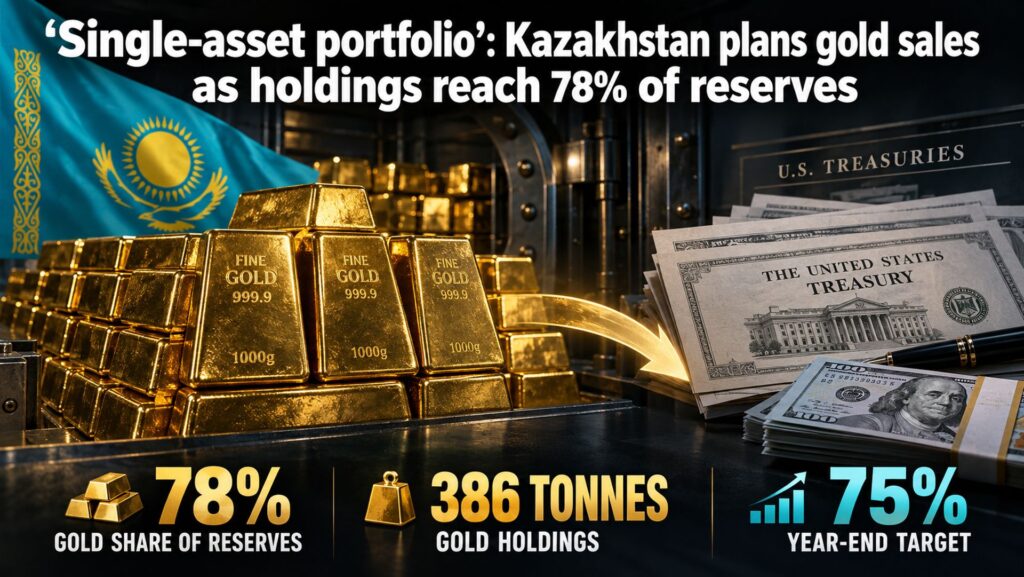
(Kitco News) –Kazakhstan’s central bank has announced plans to rebalance its reserves by selling off some of its massive gold reserves, flipping one of the world’s leading buyers into a big seller for the remainder of 2026.Aliya Moldabekova, Deputy Governor of the National Bank of Kazakhstan, explained in a recent interview that the current multi-decade highs in Treasury yields make dollar assets very attractive.“We haven’t seen levels like this in a long time,” Moldabekova said. “This makes the dollar an attractive option, thereby reducing the appeal of gold as an investment asset.”Kazakhstan’s central bank maintains the right to buy up to 100% of the gold mined in the country, the world’s eighth-largest gold producer. The central bank halted sales in February last year, and its gold reserves have since ballooned to 386 tonnes. This means gold currently represents approximately 78% of total reserves according to their estimate, which Moldabekova characterized as uncomfortably high. She said the central bank intends to lower gold’s share of its total foreign exchange reserves by about 3% by the end of the year.“With such a share of gold, our holdings are starting to resemble a single-asset portfolio,” she said, adding that the central bank’s $66.4 billion in foreign currency reserves must remain liquid.Moldabekova said half of the reduction in the gold reserve will be accomplished through sales of physical gold, with the other half coming by selling options, but if the gold price drops below $4,000 per ounce, the reserves could decline to the 75% target on their own.“Market forecasts indicate that the price of gold will continue to rise,” Moldabekova said. “Therefore, we would prefer not to plan too far ahead; rather, we would achieve the 75% level and then continue to monitor the situation from there,” Moldabekova said. “Given that significant uncertainty persists, we nevertheless expect a slight rise in the price of gold.”The National Bank of Kazakhstan has been the fourth-largest sovereign buyer of gold bullion through the first eight months of 2026, according to World Gold Council data. The WGC’s latest central bank gold update noted that the National Bank of Kazakhstan bought seven tonnes of gold in August, bringing its year-to-date gold purchases to 36 tonnes. “Kazakhstan’s gold now stands at 79% of total reserves, or about 377t,” the report noted.See live precious metals prices for gold, silver, platinum and palladium — in USD, CAD and 12 more currencies.
Gold ETF demand defies rising bond yields as investors pour $31 billion into record third quarter

(Kitco News) – Gold faces headwinds as persistent inflation pressures support higher interest rates, driving bond yields and the U.S. dollar higher. However, investors continue to see value in the precious metal, as demand for gold-backed exchange-traded funds remained positive through September.In its latest monthly ETF report, the World Gold Council (WGC) said that 67.3 tonnes of gold, valued at nearly $10 billion, flowed into global ETFs last month. The analysts added that September’s strong performance lifted third-quarter inflows to a record $31 billion, with European- and North American-listed funds leading demand.“During Q3, global gold ETFs’ total AUM rose 9%, while collective holdings grew by 211t. At the country level, the record Q3 inflow was led by the US, followed by an impressive contribution from UK-listed funds. The UK recorded its strongest quarter on record, helping Europe achieve the same milestone at the regional level,” the analysts said.Meanwhile, North American gold-backed ETFs recorded their first quarterly inflows of 2026, reversing significant investment outflows during the first half of the year.According to the WGC, North American-listed funds attracted $11.7 billion in investment inflows during the third quarter, representing 81.3 tonnes of gold. The strong quarterly performance was enough to offset earlier losses, bringing year-to-date inflows to $4.1 billion, equivalent to 20.7 tonnes.In September alone, North American-listed ETFs attracted nearly $4 billion in investment inflows, representing 27.7 tonnes of gold. U.S.-listed funds accounted for nearly all of the region’s monthly demand, attracting $3.8 billion, while Canadian-listed funds recorded more modest inflows of $206 million.“September’s inflows came despite a challenging domestic backdrop for gold. The Federal Reserve raised interest rates by 25 basis points2 during the month and signalled that further tightening could follow, contributing to upward pressure on Treasury yields and the dollar. These developments increased the opportunity cost of holding gold and weighed on its price,” the analysts said. “Nevertheless, persistent inflation and elevated energy prices, concerns over equity valuations – particularly in AI-related sectors – and increased bond-market volatility may have reinforced gold’s appeal as a portfolio diversifier. Continued inflows also suggest that some investors viewed the price pullback as an opportunity to build or maintain strategic positions rather than reduce exposure.”Across the Atlantic, European-listed gold ETFs saw inflows of 21.7 tonnes, valued at $3.6 billion. The WGC said that UK demand was the largest contributor to the region’s inflows last month.“The persistence of inflows into UK-listed funds was particularly notable. They recorded inflows in 12 of the 13 weeks through 25 September – the most consistent run since 2022 – suggesting sustained investor interest rather than a reaction to a single event. Recent inflows have coincided with a rising gilt term premium, potentially reflecting broader investor concerns over inflation uncertainty, fiscal sustainability and sovereign bond-market risks; factors that may have reinforced gold’s appeal as a portfolio diversifier,” the analysts said.Meanwhile, Asian demand, which has been a pillar of strength throughout 2026, saw its third consecutive monthly increase. Investment demand for gold-backed ETFs was led by China, while India, Japan, South Korea and Singapore also recorded inflows during the month, highlighting the breadth of regional buying.“Despite a weaker gold price, Chinese funds continued to attract inflows amid renewed weakness in domestic equities and declining government bond yields, both of which supported gold’s relative appeal. Inflows continued into Indian funds, potentially supported by a pullback in domestic equities, opportunistic dip buying and increased demand for portfolio diversification,” the analysts said.Looking ahead, WGC analysts said that bond yields could continue to play an important role in the gold market. U.S. 10-year Treasury yields remain well above 5%, even as markets see only a slim chance of a rate hike later this month.“Recent US data no longer support the case for an imminent hike, and markets have lowered tightening expectations not only for the Fed, but also for the Bank of England and the ECB. If bond yields remain elevated despite this mildly dovish repricing, it would suggest that investors are focused less on near-term policy rates and more on deeper fiscal and term-premium risks, potentially continuing to support gold demand,” the analysts said in a separate report.See live precious metals prices for gold, silver, platinum and palladium — in USD, CAD and 12 more currencies.
Gold price needs a dovish Fed or renewed debasement fears to reverse its downtrend

(Kitco News) – Investment demand in gold-backed exchange-traded funds has been resilient in the face of persistent inflation, higher bond yields and a stronger U.S. dollar; however, one bank remains cautious on the precious metal as physical demand remains weak, particularly in key global markets. (Kitco Global Index shows how much of today’s gold move is the dollar versus the gold market itself.)In their latest precious metals note, commodity analysts at Bank of America said that despite steady investment demand, they are not ready to reassess their outlook for gold prices, as they expect prices will be unable to hold above $4,000 an ounce over the next three months.“We remain cautious near-term as the macro environment remains challenging: we have an average 4Q26 forecast of $4,000/oz, but then expect prices to average $4,813 in CY27,” the analysts said in the report published Monday.In a note published at the start of the month, BofA said that it sees gold prices falling to a low of $3,750 an ounce in the fourth quarter as elevated energy prices continue to fuel inflation fears. Spot gold last traded at $4,168.90 an ounce, down 0.59% on the day. The analysts said that although ETF demand has been positive over the last two months, this could be seen as a negative, as weak prices could eventually prompt investors to liquidate their positions, adding to the selling pressure.They added that ETF demand alone can’t keep the market buoyant as the broader physical market remains weak.“Our tracker suggests that other key market participants, including central banks, China and India, have, in aggregate, slowed gold buying. This goes a long way to explaining recent gold headwinds,” the analysts said.At the same time, BofA said that central bank demand, which has been an essential pillar of strength for the global market, could become a source of weakness through year-end.“With the Middle East conflict escalating again, there is a risk that central banks could resume sales, in our view. Holdings have dipped somewhat, but this is not necessarily surprising, given that around 90% of the increase in the value of gold holdings reflected valuation gains rather than actual purchases,” the analysts said.As for what it will take for gold prices to bottom and resume their long-term uptrend, the analysts said that the market needs clearer guidance from the Federal Reserve.“Looking at correlations, causalities and Principal Component Analysis, gold rallied alongside equities when the market was not concerned about rising rates. Yet, when the Fed turned hawkish, inflation rose and the dollar appreciated, the yellow metal came under substantial pressure. The takeaway: gold will in all likelihood only bottom out once concerns over inflation/the Iran war subside, USD stops appreciating, and the Fed is no longer in a tightening cycle,” the analysts said.Although a dovish shift in monetary policy would be a more significant driver for gold, BofA said that the precious metal could also attract renewed bullish momentum if currency debasement fears pick up again.“Even though the US fiscal deficit is much discussed in the gold market, a higher term premia alone has usually not been bullish gold. As such, if fiscal policy does not become more orthodox, we believe an end to the hiking cycle, or even more powerful, a return to concern over fiscal repression would be the more significant drivers. If the Treasury intervened in the bond market, financed that by issuing short-term debt and the Fed then made sure that short-date rates remained low, this would in all likelihood reignite concerns over USD debasement – a very bullish scenario for gold,” the analysts said.See live precious metals prices for gold, silver, platinum and palladium — in USD, CAD and 12 more currencies.
Gold tests $4,200 as weak sentiment offsets sticky inflation expectations

(Kitco NewsWire) – Spot gold and silver prices were sharply higher in late U.S. trading Friday, as a softer dollar earlier in the session, a pullback from this week’s Treasury-yield extremes and bargain buying helped metals recover from the midweek selloff. At the time of writing, spot gold was trading near $4,194.50 an ounce, up 1.50% on the session, while spot silver was trading near $60.700, up 2.77%.North American equities closed higher, ending a volatile week with broad gains. The S&P 500 rose 46.18 points, or 0.6%, to 7,811.54. The Dow Jones Industrial Average gained 423.31 points, or 0.8%, to 51,654.95. The Nasdaq Composite added 172.83 points, or 0.6%, to 27,366.17, while the Russell 2000 rose 12.85 points, or 0.5%, to 2,806.98.European equities also closed higher as easing strike fears around Iran, firmer metals and lower bond-market stress supported risk appetite. The Stoxx Europe 600 gained 0.97%. Germany’s DAX rose 1.13% to 25,087.30, the U.K. FTSE 100 advanced 1.06% to 10,552.00, France’s CAC 40 climbed 0.95% to 7,803.33 and Italy’s FTSE MIB gained 0.91% to 49,746.30.Market positioning remains less hawkish for October but still exposed to December tightening risk. The preliminary October University of Michigan consumer sentiment index fell to 46.3 from 48.1 in September, while year-ahead inflation expectations rose to 4.7% and long-run expectations increased to 3.5%. That mix strengthened the growth-slowdown argument for gold but kept the inflation side of the Fed trade alive. September payrolls rose by only 29,000, unemployment held at 4.2% and July and August payrolls were revised down by a combined 60,000, while traders priced roughly a 19% chance of an October rate hike and an 84% probability of at least one 25-basis-point increase by December. The 10-year Treasury yield finished near 5.24% and the dollar index held near 102.10. The next major tests are September CPI Wednesday, September PPI Thursday and import and export prices Friday. Softer inflation would support gold by validating the payroll slowdown; a hot CPI or PPI print would keep December hike risk and real-rate pressure in the trade.The Strait of Hormuz and U.S.-Iran situation remains a supply-risk overhang, even as near-term strike fears eased. Oil initially fell after President Donald Trump said Washington was having productive discussions with Tehran and would not attack Iran before the Nov. 3 midterm elections, while Iran reviewed a U.S. response to a proposal that would reopen the strait within seven days. The pressure did not clear by the close: threats to shipping in the Gulf and the Strait of Hormuz have increased, the waterway carried about 20% of global oil and fuel shipments before the war, the U.S. imposed new sanctions on 17 vessels tied to Iranian energy flows and Hurricane Isaias shut in more than 1.3 million barrels per day of U.S. Gulf output. Brent crude settled at $104.72 a barrel, up 0.42%, while WTI settled at $91.85, up 0.39%. For gold, the channel remains mixed: lower immediate strike risk trimmed some safe-haven urgency, but high crude, diesel tightness and tanker risk keep inflation expectations, yields and defensive demand inside the metals trade.The key outside markets see Nymex WTI crude oil prices higher and trading near $91.85 a barrel, while Brent crude settled near $104.72. The yield on the benchmark 10-year U.S. Treasury note is trading near the 5.24% area. The U.S. dollar index is steady near 102.10. (Kitco Global Index shows how much of today’s gold move is the dollar versus the gold market itself.)Technically, spot gold bulls’ next upside price objective is to push prices back above the $4,225.81 to $4,233.10 resistance zone, with a sustained move targeting $4,272.41 and then $4,319.60. Bears’ next near-term downside price objective is a break below $4,183.83, with deeper downside targets at $4,141.86 and then $4,103.24. First resistance is seen at $4,225.81 and then at $4,230.51. First support is seen at $4,183.83 and then at $4,141.86.Spot silver bulls’ next upside price objective is to drive prices back above the $61.720 to $63.060 area, with a move above that zone targeting $64.270 and then $65.090. The next downside price objective for the bears is a break below $59.960, with deeper downside targets at $58.940 and then $57.640. First resistance is seen at $61.720 and then at $63.060. Next support is seen at $60.623 and then at $59.960.See live precious metals prices for gold, silver, platinum and palladium — in USD, CAD and 12 more currencies.
Wall Street nears bullish majority after gold’s late-week rally, Main Street fails to reclaim bullish bias as inflation data take center stage
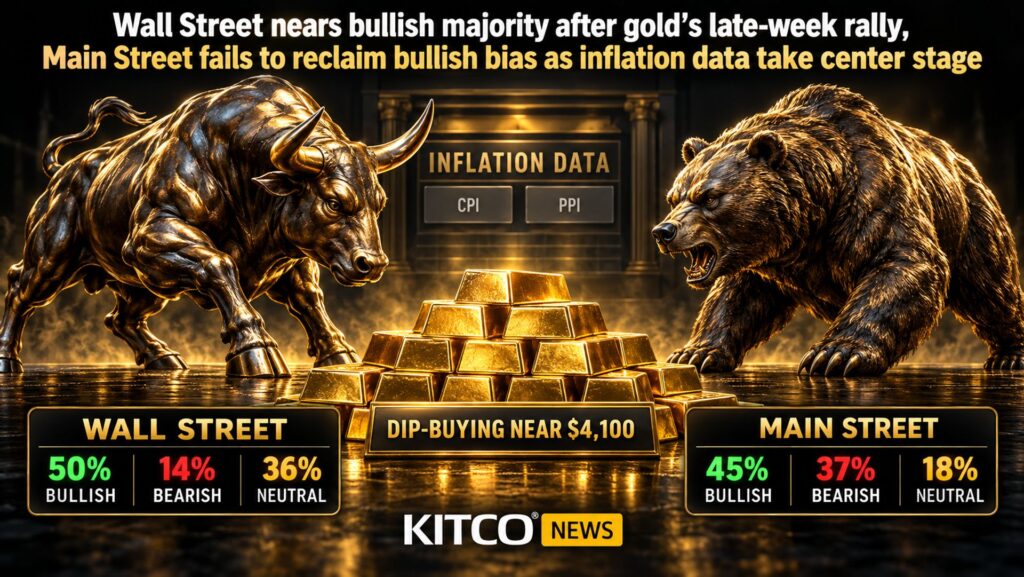
(Kitco News) – Gold prices finished the week higher after a volatile stretch, as early pressure from rising Treasury yields, a firmer U.S. dollar, and renewed inflation concerns gave way to a late-week rebound driven by softer yields, lower oil prices, and renewed dip-buying near $4,100 per ounce.Spot gold kicked off the week trading at $4,142.40 per ounce on Sunday evening, and the yellow metal initially pushed higher as traders continued to assess the inflationary impact of the U.S.-Iran conflict, elevated oil prices, and another round of central bank gold buying from China. The rally stalled Tuesday as the dollar and yields strengthened, and gold came under heavier pressure after the minutes of the September Fed meeting showed most policymakers still expected another rate increase would be needed before year-end.The selling accelerated Wednesday as rate hike expectations and a stronger dollar kept pressure on non-yielding assets, with spot prices setting their weekly low at $4,066.31 per ounce before buyers returned near the lower end of the recent range. Gold recovered Thursday after a strong 30-year Treasury auction helped yields retreat from the morning highs, even as oil’s surge kept inflation risk and December Fed-tightening expectations in the trade.Friday delivered the strongest move of the week, as the U.S. dollar softened, Treasury yields eased, and oil prices pulled back after reports of productive U.S.-Iran talks reduced some of the downward pressure on prices. The rebound gained further traction after preliminary University of Michigan consumer sentiment fell to 46.3 and inflation expectations rose, reinforcing gold’s appeal as an inflation hedge while keeping next week’s CPI and PPI data in focus.After climbing to its weekly high of $4,207.48 per ounce early Friday morning, spot gold eased into the weekend trading just $5 short of the key $4,200 resistance level.The latest Kitco News Weekly Gold Survey showed Wall Street back on the brink of a bullish majority, while less than half of Main Street believed gold would gain ground next week.“Up,” said Darin Newsom, senior market analyst at Barchart.com. “Fundamentally, the market hasn’t changed. However, if the latest mood of the US president holds and he decides not to bomb Iran again until after US midterm elections, the Energies sector could come down and metals rally. Technically, Dec gold is oversold and could post a short-term bullish close Friday if it settles above the previous high daily settlement of $4,187.10 (October 6). Dec remains well below its 45-day moving average calculated near $4,398, meaning there is some space to move higher short-term.”“Unchanged,” said Adrian Day, president of Adrian Day Asset Management. “We expect more back and forth until an end to the war, leading to expectations of lower CPI and less pressure on central banks to hike. The end of the war would also remove the safe-haven premium on the dollar. We don’t expect a large decline but no breakout either.”“Up,” said James Stanley, senior market strategist at Forex.com. “I think we may have seen capitulation this week as there was a clean sell-off and sellers quickly backed away from the lows. Closing the weekly bar in the green is notable and while trying to predict bottoms is tough, there’s mounting evidence that gold is continuing to see buyers show at or around the $4k level.”“Up,” said Rich Checkan, president and COO of Asset Strategies International. “The overriding belief now is there will be no Fed interest rate hike at the October FOMC Meeting. So, that should take some of the short-term pressure off gold. Treasury yields and a strong U.S. dollar will cap appreciation, but gold should still climb over the next week.”Kevin Grady, president of Phoenix Futures and Options, is watching next week’s CPI report for gold’s near-term reaction as well as clues about the Fed’s medium-term direction, but warned that one number doesn’t truly capture the complexity of the situation.“We have some inflation numbers coming out next week, which I think are going to be important,” he said. “I think we have to just wait on the data. We also have earnings coming out, and I think earnings are going to be great. I think the markets look positive. I think a lot of the news coming out has been positive.”“I just think it’s about how the Fed wants to digest that data,” Grady added. “We saw the bad jobs number of 29,000. Everyone’s saying it’s clear markets rallied on that, because they’re not going to be raising rates again. Right now, everyone’s just in this position of trying to figure out what the Fed’s going to do. We’re stuck at a level, and we have to just wait it out and see where we land on this.”“It’s just one of those things; you don’t really have a choice. We have to just wait it out.”Grady said he thinks gold has lost the support it was enjoying from the debasement trade, and it’s now watching other markets for future direction.“We’re trying to figure out month to month, on each number, what’s moving,” he said. “If that 0.2% changed what the Fed’s going to do… there’s a lot of things right now that gold is waiting on.”“The key thing is, with everything going on, with where the bond market and yields are, gold is holding up.”Grady said that while he expects gold to continue trading in its recent range, he expects enormous volatility within that range because of the automated trading that’s dominating the market right now.“I think it’s very tick sensitive because the people aren’t trading; it’s the algos,” he said. “The algos trade literally every word that comes out. So the volatility in the market is not coming from traders trying to pick and see where the market’s going. It’s algorithms that are in there trading literally off the verbiage that is coming out. Every single sentence, every word is digested by an algorithm, and the algorithm [reacts].”Grady expects next week’s inflation numbers to come in hotter than expectations. “The inflation numbers have been kind of muted, but I think it’s going to hit this month,” he said. “It’s tied into energy prices and that’s just a fact of it. I think the market’s going to digest that; I think they’re going to be factoring into it. It’s going to be a higher print for inflation.”“It’s not like this is the long-term inflation numbers,” he added. “I think that’s what people are trying to decipher. Is this short-term? Is it long-term? There are so many moving parts to it. I just don’t think we’re going to be trading off of that one number.”This week, 14 analysts participated in the Kitco News Gold Survey, with half of Wall Street leaning bullish once again after gold’s positive weekly performance. Seven experts, or 50%, expected to see gold prices gain ground during the week ahead, while only two, representing 14%, saw the yellow metal declining. The remaining five analysts, 36% of the total, said they couldn’t predict gold’s direction, or expected sideways churn next week.Meanwhile, 206 votes were cast in Kitco’s online poll, with Main Street investors still failing to reclaim their bullish majority despite gold’s price resilience. 93 retail traders, or 45%, looked for gold prices to rise next week, while 77 others, or 37%, predicted the yellow metal would lose ground. The remaining 36 investors, representing 18% of the total, expected to see sideways price action during the week ahead.Inflation data will be the major focus next week, with the release of September’s Consumer Price Index and Producer Price Index reports, but markets will also be watching key regional manufacturing surveys and comments from Fed chair Kevin Warsh.Tuesday morning will see the release of Existing Home Sales for September. Then on Wednesday morning, the CPI report will be the focus, followed on Thursday by PPI, along with Retail Sales for September, weekly jobless claims, and the Philly Fed and Empire State manufacturing surveys.Then on Thursday evening, traders will watch for comments from Federal Reserve Chair Warsh when he speaks at an IMF event in Bangkok.Marc Chandler, managing director at Bannockburn Global Forex, sees gold prices under pressure next week. “In the past week and a half or so, gold basis spot has moved above $4200 on an intraday basis only to be greeted by sellers,” he said. “It must reestablish a foothold above $4230 to suggest a base has formed. Next week, the US will likely report CPI accelerated and with the pendulum over Fed expectations through the middle of next year at the lower end of their recent range, the adjustment could weigh on the yellow metal.”Colin Cieszynski, chief market strategist at SIA Wealth Management, believes gold’s next major pivot will likely come on the back of geopolitical developments.“I’m neutral on gold right now,” he said. “It seems to me like it’s just range-bound, and that’s fine. There’s nothing wrong with that.”Cieszynski said he’s continuing to keep an eye on Treasury yields, but there are plenty of potential sources of volatility for the precious metals these days.“It’s an interesting time, because we’ve seen that things could just come out of nowhere,” he said. “But they could come out of nowhere in either direction. World peace could break out, and oil goes down, and yields go down, and gold goes up, or the dollar goes down and gold goes up, or the opposite, the yields go up and the dollar goes up and gold goes down. We’re just stuck in this back and forth, almost a tug of war, and at this point it’s hard to determine which way things are heading.”“But what is clear is the Fed is looking for any excuse to not do anything at the next meeting,” Cieszynski said. “We’ll see what happens with inflation next week, but other than that, I expect things to be pretty quiet.”Cieszynski said the market is reflecting the current situation and the more probable outcomes quite well right now. “Unless we see something significant kind of change, I think we’re just treading water for the moment.”He pointed out that there are several important elections happening around the world, not just the U.S. midterms, and gold could move on the results.“The inflection point might be closer to the US elections, or after the US elections,” he said. “And there’s other elections. There’s a whole bunch of elections in various places happening over the next month or so.”“The administration seems to want to kick everything till after the midterms, and then let’s see what happens with the midterms,” he added. “Does that increase or decrease confidence? Nobody really knows at this point.”“After the dust settles, we’ll see some of the results of all these various elections, and we can get a better sense of where the world is heading politically.”Alex Kuptsikevich, senior market analyst at FxPro, sees gold prices trending higher next week.“Gold rose by almost 3% in the second half of the week, which may well have marked a turning point,” he said. “The precious metal attracted buyers as the price entered the June–July support zone. This is well above the lower boundary of that range at $4,000, a level towards which we had expected the price to fall. Buyers were also supported by increased risk appetite on Thursday, which not only allowed the market to recoup the week’s losses but also pushed it into positive territory, closer to $4,200.”“Gold has plenty of room to rise over the next couple of weeks, with no technical barriers until the $4,300-4,350 range,” Kuptsikevich said. “However, this does not promise an easy ride, as market debt problems are rarely resolved quickly or on their own. We are almost certain that the European debt crisis will escalate, which could put pressure on gold, as it has been doing since the end of August. Furthermore, the dollar has probably merely taken a breather after four weeks of gains, but has not yet peaked. We therefore expect some further relief for gold next week, but significant challenges lie ahead in the longer term. Often, following elections, the dollar strengthens as political risks recede.”Michael Moor, founder of Moor Analytics, expects gold prices to post further gains next week.“HIGHER, unless we fail below the formation mentioned below,” he wrote. “In a Higher time frame: I cautioned on 8/16/18 the break above $1,183.0 warned of renewed strength. We have seen $4,443.1. These are OFF HOLD. We held exhaustion with a 56268 high and rolled over $1,651.1. This is ON HOLD. On a medium timeframe basis: The trade below 52554 projected this down $740 (+)—we attained $1,300.0. The trade below 52036 brought in $1,248.2 of pressure. The trade below 51606 brought in $1,205.2 of pressure. These are ON HOLD. We held exhaustion with a 49177 high after a pullback and rolled over $962.3. The break below 48185 projected this down $185 (+)—we attained $863.1. The trade below 47923 projected this down $205 (+)—we attained $836.9. These are ON HOLD. We held macro exhaustion with a 39554 low and bounced $799.6—if we continue in a bona fide bullish correction, the minimum target is 49636. This is OFF HOLD.”“On a lower timeframe basis: We held exhaustion with a 40190 low and bounced $736.0,” Moor said. “This is OFF HOLD. The break below 46369 brought in $545.7 of pressure. The break below 45886 projected this down $205 (+)—we attained $497.4. The trade below 44227 projected this down $65 min, $500 (+) max—we attained $331.5. The break below 43582 has brought in $267 of pressure. The break below 43043 brought in $213.1 of pressure, the break below 42820 brought in $190.8 of pressure, and the break back below 41949 brought in $103.7 of pressure; but I will no longer mention these. We held exhaustion at 41003 with a 40912 low and bounced $142.5. The trade above 41647 (-7.8 tics per/hour projects this upward $90 minimum, $175 (+) maximum—we have attained $69.0. The trade above 41784 (-7 tics per/hour) projects this upward similarly—we have attained $55.3. If we break back below either decently, look for decent pressure. A maintained gap higher will leave a minor bullish reversal.”At the time of writing, spot gold last traded at $4,194.64 per ounce for a gain of 1.28% on the week and 1.47% on the day.See live precious metals prices for gold, silver, platinum and palladium — in USD, CAD and 12 more currencies.
Gold, silver rebound as dollar, yields and oil ease

(Kitco NewsWire) – Spot gold prices are sharply higher and spot silver prices are also solidly higher in early U.S. trading Friday, as a softer U.S. dollar, easing Treasury yields and a pullback in oil prices helped metals recover from this week’s rate- and energy-driven selloff. At the time of writing, spot gold was trading near $4,184.80 an ounce, up 1.27% on the session, while spot silver was trading near $60.440, up 2.32%.Market positioning remains less hawkish for October but still exposed to December tightening risk. Initial jobless claims fell to 197,000 last week, while continuing claims rose to 1.716 million, reinforcing a low-layoff, slow-hiring labor market after September payrolls rose by only 29,000 and July and August payrolls were revised down by a combined 60,000. Fed minutes released Wednesday showed most policymakers still expected another rate increase by year-end, and Friday pricing put the probability of an October hike near 17% to 19%, while December hike odds remained near 82% to 83%. The 10-year Treasury yield was near 5.25% after Thursday’s strong 30-year auction eased pressure at the long end. Friday’s preliminary October consumer sentiment and inflation-expectations data are the next immediate test, followed by September CPI and PPI next week. Softer sentiment or inflation expectations would support gold by validating the payroll slowdown and lower-yield move; sticky expectations or a hot CPI print would keep the December hike channel active against bullion.The Strait of Hormuz and U.S.-Iran situation remains a supply-risk overhang, but the immediate market impact turned less inflationary Friday. Oil prices retreated after President Donald Trump said the U.S. would not attack Iran before the Nov. 3 midterm elections and that talks were productive, reducing the near-term strike premium that had pushed Brent above $104. Threats to Gulf and Hormuz shipping have still increased in October, and the strait carried shipments equal to about 20% of global oil and fuel before the war. Iran is reviewing a U.S. response to a seven-day reopening proposal, while Washington added sanctions on 17 vessels tied to Iranian crude, oil products and petrochemicals. Lower oil helped gold through softer inflation expectations, lower yields and a weaker dollar, while also supporting silver’s risk-sensitive industrial channel.Global risk tone improved before the U.S. open. S&P 500 futures were up 0.4%, Dow futures were up 0.1% and Nasdaq futures were up 0.7%, as lower oil and calmer yields offset Thursday’s technology-led decline. European equities were higher, with the DAX up 1.0%, the CAC 40 up 0.6% and the FTSE 100 up 0.9%, while Asian markets were mixed and South Korea and Taiwan were closed.The key outside markets see Nymex WTI crude oil prices lower and trading near $90.41 a barrel, while Brent crude was near $102.58. The yield on the benchmark 10-year U.S. Treasury note is trading near the 5.25% area. The U.S. dollar index is softer. (Kitco Global Index shows how much of today’s gold move is the dollar versus the gold market itself.)Technically, spot gold bulls’ next upside price objective is to push prices back above the $4,183.83 to $4,225.81 resistance zone, with a sustained move targeting $4,271.57 and then $4,311.17. Bears’ next near-term downside price objective is a break below $4,183.83, with deeper downside targets at $4,141.86 and then $4,103.24. First resistance is seen at $4,225.81 and then at $4,271.57. First support is seen at $4,183.83 and then at $4,141.86.Spot silver bulls’ next upside price objective is to drive prices back above the $61.720 to $63.060 area, with a move above that zone targeting $65.090 and then $72.000. The next downside price objective for the bears is a break below $59.960, with deeper downside targets at $58.940 and then $57.640. First resistance is seen at $61.720 and then at $63.060. Next support is seen at $59.960 and then at $58.940.See live precious metals prices for gold, silver, platinum and palladium — in USD, CAD and 12 more currencies.
Gold price trades near high after preliminary Consumer Sentiment falls to 46.3, inflation expectations rise

(Kitco News) – The gold market is trading not far from session highs after the latest data showed consumer sentiment in the U.S. declining further, with inflation expectations rising higher.The University of Michigan announced on Friday that the preliminary reading of its Consumer Sentiment survey for October was 46.3. The data was worse than expectations, as the consensus forecast of economists called for a reading of 47.6, and it was also well below September’s final reading of 48.1.“Consumer sentiment was little changed this month, inching down a scant 1.8 index points from September,” said Surveys of Consumers Director Joanne Hsu. “While year-ahead expectations for personal finances and business conditions crept up slightly, buying conditions for durables plummeted amid high prices and borrowing costs. Increases in sentiment among Democrats and Republicans were offset by a decline among independents this month.”“Overall, sentiment for lower-income consumers and those with smaller stock portfolios dropped steeply this month, groups that have fewer resources to weather increases in prices,” she added. “Frustration over cost-of-living continues to mount, as consumers across the political spectrum believe that the trajectory of the economy has weakened since the beginning of the year.”Spot gold continued to trade near the upper edge of its daily range in the minutes following the 10 am ET data release, and last traded at $4,188.36 per ounce for a gain of 1.32% on the day.The October index showed another rise in year-ahead inflation expectations, while longer-run expectations also ticked higher.“Year-ahead inflation expectations ticked up from 4.6% last month to 4.7% this month,” Hsu wrote. “The current reading substantially exceeds the 3.4% seen in February before the Iran conflict began, along with all 2024 readings. Long-run inflation expectations also stepped up from 3.4% in September to 3.5%, notably higher than their 2024 range of 2.8% to 3.2%. Inflation expectations over both time horizons increased for the second straight month to their highest readings since May.”