Gold firms, silver slides as oil surge revives inflation pressure

(Kitco NewsWire) – Spot gold prices are firmer and spot silver prices are sharply lower in early U.S. trading Thursday, as another jump in oil prices and Treasury yields kept inflation and Fed tightening risk at the center of the metals trade. At the time of writing, spot gold was trading near $4,128.20 an ounce, up 0.45% on the session, while spot silver was trading near $58.830, down 1.40%.Market positioning remains caught between a soft payrolls signal and a still-hawkish inflation backdrop. Initial jobless claims fell to 197,000 in the week ended Oct. 3, down 2,000 from the prior week’s revised level, while continuing claims rose to 1.716 million for the week ended Sept. 26. Last week’s payrolls report showed only 29,000 jobs added in September, but Fed minutes released Wednesday showed most policymakers still expected another rate increase by year-end. The 10-year Treasury yield was near the 5.3% area, the 30-year yield remained near 24-year highs and traders were watching Thursday’s $22 billion 30-year Treasury auction, Friday’s preliminary October consumer sentiment report and next week’s CPI data. Softer labor or sentiment data would support gold by reinforcing the payroll slowdown; firm inflation expectations, weak auction demand or another oil-driven rise in yields would keep pressure on bullion.The Strait of Hormuz and U.S.-Iran situation remains the dominant oil-market risk and the main indirect headwind for gold through inflation and yields. Brent crude jumped above $104 a barrel and WTI traded above $92 after another tanker was hit north of Qatar, while attacks on vessels around the Gulf and Hormuz reached their highest weekly pace since the Iran war began. Hurricane-related U.S. Gulf shutdowns added to the supply squeeze, with about a quarter of current Gulf of Mexico oil output shut in. The geopolitical channel is normally supportive for gold, but Thursday’s market transmission was more complicated: higher oil lifted inflation expectations, pushed yields higher and weighed on equities and silver.Global risk tone weakened before the U.S. open. Dow e-minis were down 462 points, or 0.9%, S&P 500 e-minis fell 39.5 points, or 0.5%, and Nasdaq 100 e-minis lost 231.75 points, or 0.73%, with megacap technology and chip shares lower as yields climbed. The pullback followed Wednesday’s retreat from record highs in the S&P 500 and Nasdaq and came ahead of the long-bond auction, which will test demand for duration after this week’s surge in borrowing costs.The key outside markets see Nymex WTI crude oil prices higher and trading near $92.28 a barrel, while Brent crude was near $104.75. The yield on the benchmark 10-year U.S. Treasury note is trading near the 5.3% area. The U.S. dollar index is firmer. (Kitco Global Index shows how much of today’s gold move is the dollar versus the gold market itself.)Technically, spot gold bulls’ next upside price objective is to push prices back above the $4,151.29 to $4,199.06 resistance zone, with a sustained move targeting $4,226.00 and then $4,230.51. Bears’ next near-term downside price objective is a break below $4,118.19, with deeper downside targets at $4,103.00 and then $4,066.00. First resistance is seen at $4,151.29 and then at $4,199.06. First support is seen at $4,118.19 and then at $4,103.00.Spot silver bulls’ next upside price objective is to drive prices back above the $60.451 to $61.162 area, with a move above that zone targeting $62.046 and then the 50-day moving average near $64.210. The next downside price objective for the bears is a break below $58.681, with deeper downside targets at $57.000 and then $54.780. First resistance is seen at $60.451 and then at $61.162. Next support is seen at $58.681 and then at $57.000.See live precious metals prices for gold, silver, platinum and palladium — in USD, CAD and 12 more currencies.
Peter Schiff says rising yields are ‘the most bullish thing’ for gold, warns Washington could pay 50 cents on the dollar

(Kitco News) – Schiff tells Kitco News anchor Jeremy Szafron that 9% mortgages and a 30% to 50% drop in home prices could be next, and why he holds more of his own money in gold miners than bullion..embed-container { position: relative; padding-bottom: 56.25%; height: 0; overflow: hidden; max-width: 100%; } .embed-container iframe, .embed-container object, .embed-container embed { position: absolute; top: 0; left: 0; width: 100%; height: 100%; }The bond sell-off that just pushed U.S. borrowing costs to a 24-year high is only getting started, Peter Schiff told Kitco News anchor Jeremy Szafron, and it could end with Washington paying its lenders 50 cents on the dollar.”It’s not really about a bluff. It’s the chickens finally coming home to roost,” Schiff said Wednesday as the Treasury got ready to sell $39 billion of 10-year notes.The 10-year yield touched 5.35% that day, its highest since 2002, before easing after the auction, CNBC reported. Mortgages have followed. The average 30-year rate hit 7.49% in the week ended Oct. 2, the highest since November 2023, according to the Mortgage Bankers Association. The Federal Reserve added to the pressure in September with its first rate hike since 2023.Schiff, a longtime gold bull who made his name warning about the housing bubble before the 2008 financial crisis, says this time the borrower in trouble is Washington itself.”This is not the end of this move. We’re probably closer to the beginning,” he said.In 2008, the government bailed out everyone else. Next time, Schiff said, it’ll be the one that needs help. “It won’t be in a position to bail out anybody in this crisis because it’s going to need a bailout,” he said. “But of course, there’s nobody big enough to bail out the U.S. government.”A 20-year bear marketSchiff believes the 40-year bull market in bonds ended in 2020 and 2021. Over those four decades, Freddie Mac’s average 30-year mortgage rate fell from 18.63% in October 1981 to 2.65% in January 2021.Now he expects the reverse: “a secular bear market that will last at least half as long as the bull market, so maybe 20 years.” He thinks rates are “probably going to rise faster than they fell.”Housing is where people will feel it first.”We could be looking at 9% mortgage rates maybe by the first quarter of next year,” Schiff said. He sees home prices falling 30% to 50% nationwide, a drop “as big if not bigger” than the one in 2007 and 2008.For decades, homeowners could refinance, pull out cash and spend it. Schiff says those days are gone. “The refi is dead. Home equity extractions are over,” he said. “So there’s no more lifeline.”‘A stealth default’Schiff describes the U.S. as stuck in what he calls the “fourth quadrant”: high debt and high interest rates at the same time. For years, low rates made a big debt load manageable. That’s no longer the case.He sees two ways out. Washington can inflate, which he called “a stealth default,” or it can restructure.”I think there is a reasonable probability that the government will default,” he said. “It’s more likely to be a restructuring where they say, ‘OK, you get 50 cents on the dollar.'”Net interest on the federal debt already runs about $1 trillion a year, according to the Congressional Budget Office. Schiff thinks that could reach $3 trillion to $4 trillion “in a few years” as old debt gets refinanced at higher rates.He’s also critical of the Treasury’s buybacks. The department plans to buy back up to $6 billion of bonds maturing between 2047 and 2056 on Thursday. Schiff calls it “an Operation Twist,” retiring long-term debt while issuing short-term bills, and warns it could backfire.”If I’m right about interest rates rising in the future, then the government is doing the worst thing you can possibly do,” he said.’The most bullish thing’ for goldGold fell nearly $100 an ounce at its low Wednesday as yields climbed. Spot prices hovered near $4,100 during the interview, well off January’s record above $5,500.The usual thinking is simple: gold pays no interest, so when bonds pay more, gold looks less attractive. Schiff says traders have it backward.”It’s the most bullish thing that could happen to gold and silver because what these rising bond yields show is that bond prices are collapsing,” he said. “Bond investors are losing money, and if they want to stop losing money, they have to sell their bonds. Well, what are they going to buy with the proceeds? Gold or silver.”He blames gold’s recent declines on trading algorithms that sell gold whenever rates rise. “Garbage in, garbage out,” he said.In the 1970s, he noted, rates and gold climbed together. What matters is whether rates keep up with inflation.”What if interest rates go to 20% but inflation is 30%?” he asked. “I’d rather own gold and earn nothing, and avoid the 30% loss.”Central banks clearly haven’t been scared off. China’s central bank reported adding about 23 tonnes in September, its 23rd straight month of buying. Central banks worldwide bought a net 39 tonnes in August, according to the World Gold Council.Some are selling. The council’s data show Russia’s central bank has sold 56 tonnes this year. Schiff says that’s exactly what gold is for when a country at war needs cash: “It’s a reserve you can actually tap into.”Eventually, he expects the sellers to run out. “Gold’s going to be the last safe haven standing,” he said.Delegates at the London gold market’s annual conference this week put gold near $5,000 a year from now. Schiff thinks it could happen faster. “The last time we moved up to 5,000, we went there very quickly. So we may go up there even quicker the next time,” he said.The spark, he said, may be a crisis like the 2023 collapses of Silicon Valley Bank and Signature Bank. “They tighten until something breaks, and then they stop,” he said of the Fed.Silver, Schiff said, has settled around $60. That’s comfortably above the old double top near $50 that it couldn’t clear in 1980 or 2011.”I don’t think $125 an ounce was the high. That was just the initial breakout point,” he said. “We’re going a lot higher next time, I think.” Every currency sinksThe dollar neared its high for the year this week as nervous investors bought it for safety, according to Bloomberg. Schiff isn’t impressed.”All fiat currencies sink,” he said. “They just sink at different rates.” He expects the dollar to start losing value faster than many other currencies and, eventually, to lose its status as the world’s reserve currency.Where his money isSo where does he keep his own money?”I have more of my own money, a lot more of my own money actually, in mining stocks than I do in physical bullion,” said Schiff, whose businesses include a precious metals dealer and a gold equities fund. “I want to own the gold that’s still in the ground.”He leans toward royalty companies and junior miners. He thinks the juniors will lead the next leg higher, which he says “hasn’t really started yet.”For everyday savers, he called holding a U.S. bond fund “a mistake” and prefers money markets for cash. His most practical advice had nothing to do with markets: “What you should do is do next year’s grocery shopping now.”He means non-perishables, stacked in the cupboard, the basement and the closet. “If the stuff that you are buying today costs 10% more or 20% more in a year … that’s a 10% or a 20% tax-free return by buying it now,” he said.Americans expect 3.9% inflation over the next year, the highest since May 2023, according to a New York Fed survey released Wednesday. Schiff thinks they’re lowballing it. “They’re going to get something much higher than that.”AI: borrower, not lenderSchiff also sees the AI boom pushing rates higher, because the biggest tech companies have switched sides.”These companies used to have cash, and they bought Treasuries with that cash. They were lending money to the government,” he said. “Now they’re borrowing in competition with the government.”It came up at the Fed, too. Minutes from its September meeting, released Wednesday, cited market commentary pointing to “competition for capital from heavy private debt issuance” to fund AI infrastructure as one reason Treasury yields have climbed.Schiff does see one way out. “There is a chance that the result of this investment so dramatically increases productivity that we get a get out of jail free card,” he said.He just can’t say whether the odds are 10% or 20%. “You’ve got a ticking time bomb here, and I don’t know when it goes off.”Buyers still showed upNot everything Wednesday looked like a buyers’ strike. At the 10-year auction, primary dealers, the banks that absorb whatever other bidders don’t take, were left with just 2.5% of the notes, well under the 9.4% average, CNBC reported. BMO called the sale “strong.” Even so, the 5.3% auction yield was the highest since 2000.The Fed minutes showed policymakers voted unanimously in September to raise rates to a range of 3.75% to 4%. “Most participants” said another increase would likely be appropriate by year-end, while longer-term inflation expectations stayed stable. Traders on the prediction market Kalshi this week put the odds of another hike before year-end near 78%.Schiff’s own fix is to deal with the debt now. Rather than promise bondholders 100 cents on the dollar and let inflation shrink it to 20 cents’ worth, he’d rather restructure up front.”How about if we say, ‘We’re not going to create any inflation, but we’re going to give you 50 cents on the dollar instead’?” he said. “But that’s a real 50 cents. That’s better than getting a dollar that’s worth 20 cents.”Watch the full interview with Peter Schiff above, and subscribe to Kitco News on YouTube for more interviews. This interview is brought to you by Kalshi, offering the first CFTC-regulated gold and silver perpetuals in the U.S. Availability varies by jurisdiction. Not available in Canada. https://kalshi.com/p/KT2026
Gold to hit $5,000, silver $97 in the next 12 months
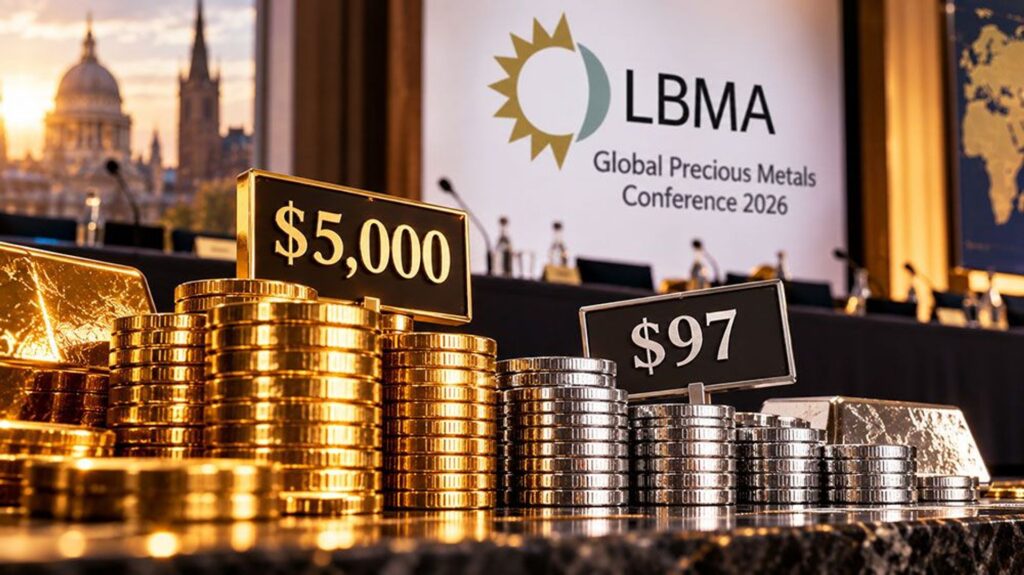
(Kitco News) – The ongoing energy crisis, persistent inflation and surging bond yields continue to create significant near-term headwinds for gold and silver, but those challenges have done little to shake the precious metals industry’s long-term bullish conviction.If anything, sentiment at the 2026 London Bullion Market Association (LBMA) Global Precious Metals Conference suggested that the fundamental case for gold is broadening as central banks diversify their reserves, geopolitical fragmentation reshapes the global monetary system and rising sovereign debt raises questions about the traditional safe-haven role of government bonds.According to the conference’s annual price survey, delegates see gold prices trading around $5,013.30 an ounce by this time next year, representing a roughly 20% gain from current levels. Spot gold last traded at $4,163.30 an ounce, up 0.57% on the day.The bullish outlook comes after last year’s forecast significantly missed the mark. At its 2025 conference, delegates expected gold prices to be around $4,980.30 an ounce.Gold has struggled through 2026 as the U.S.-Iran war has driven oil prices higher, fueling inflation and forcing central banks to maintain tightening biases. Rising interest rate expectations have helped to pushed long-dated bond yields to their highest levels in roughly 20 years.However, a recurring theme throughout the two-day conference was that the forces traditionally considered negative for gold are becoming increasingly complicated.Higher bond yields increase the opportunity cost of holding non-yielding gold, but speakers noted that rising sovereign debt and deteriorating fiscal positions are also pushing term premia higher and raising questions about the long-term reliability of government debt.“I think, in a way, gold is sending us a message that maybe the global debt is reaching an inflection point where the supply of paper may probably overwhelm the demand,” said Vikram Dhawan, Head of Commodities and Fund Manager at Nippon India Mutual Fund during a panel discussion.Central bank demand was another major theme, with reserve managers increasingly viewing gold as more than simply an inflation or geopolitical hedge.Highlighted during the conference, UBS Asset Management’s latest Reserve Management Survey, 65% of respondents identified diversification as the primary reason for holding gold. Gold was also among the leading assets central banks expect to add to their reserves during the next 12 months.Several central bankers highlighted gold’s unique status as an asset that is no one else’s liability. Speakers noted that geopolitical fragmentation, sanctions and concerns about sovereign credit risk have increased the appeal of holding an asset without counterparty or default risk.At the same time, analysts said persistent fiscal deficits and rising government debt continue to support the “debasement trade,” as investors look to protect their purchasing power against the long-term erosion of fiat currencies.Delegates were even more bullish on silver, forecasting prices to rise to $94.70 an ounce during the next 12 months. The forecast represents a gain of more than 54% from current levels. Spot silver last traded at $61.23 an ounce, up 0.50% on the day.Silver is already trading above the $59.10 forecast made at the 2025 conference despite suffering a significant correction from this year’s highs.Although elevated prices are forcing industrial users to reduce silver consumption where possible, conference participants said structural demand remains healthy.Photovoltaic manufacturers continue to thrift silver as costs rise, but speakers noted that the metal remains difficult to completely replace in solar technology. Meanwhile, continued growth in artificial intelligence infrastructure, electric vehicles and broader electrification is expected to create long-term demand for both silver and gold.Physical investment demand has also remained resilient, with dealers reporting periods earlier this year when tight inventories and strong buying made it difficult to meet demand.Ultimately, the message from the conference was that investors should expect continued volatility as precious metals compete with elevated interest rates and bond yields. However, delegates see structural demand from central banks, sovereign debt concerns, geopolitical uncertainty and expanding industrial consumption continuing to support higher prices over the longer term.See live precious metals prices for gold, silver, platinum and palladium — in USD, CAD and 12 more currencies.
China’s central bank buys 21 tonnes of gold in September, largest monthly purchase in 3 years
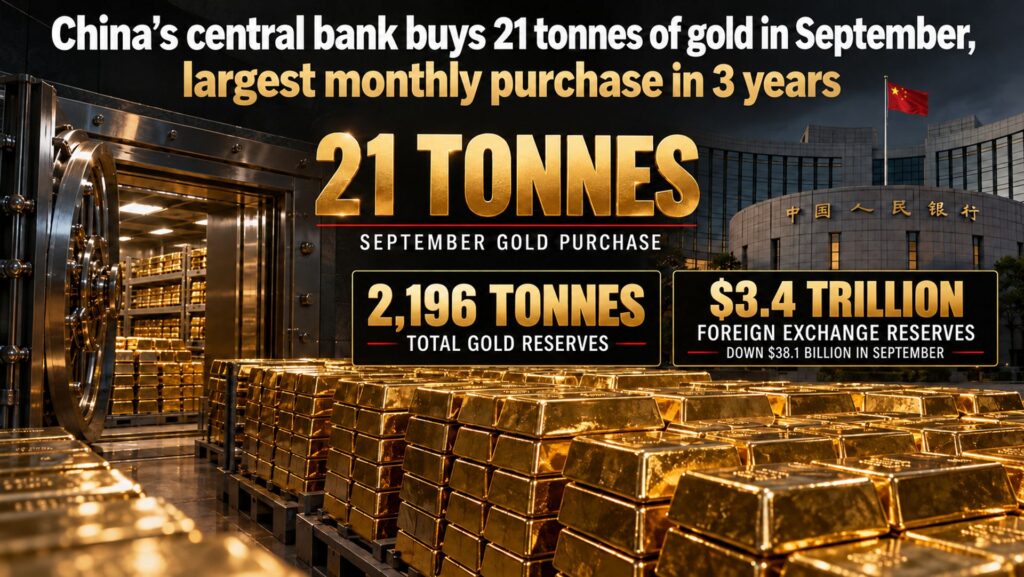
(Kitco News) – China ramped up its gold purchases in September as bullion prices declined, recording the largest monthly increase in its official reserves in three years, the People’s Bank of China announced on Wednesday.The central bank increased its gold reserves by 21 tonnes last month to 2,196 tonnes as of the end of September, marking the 23rd consecutive month of purchases, according to the PBoC.The massive purchase was the largest since September 2023, when reserves rose by 24 tonnes, according to Chinese market tracker Wind Info. It also exceeded the previous months’ purchases of 18.5 tonnes in August and 18 tonnes in July.China’s foreign exchange reserves stood at $3.4 trillion at the end of September, down $38.1 billion, or 1.11%, from a month earlier, according to State Administration of Foreign Exchange data (SAFE).SAFE attributed the decline to the combined effects of currency translation and changes in asset prices, as the U.S. dollar index rose and prices of major global financial assets generally fell during the month. They added that China’s economy remained broadly stable, with new growth drivers gaining strength, supporting the overall stability of foreign exchange reserves.The PBoC has ramped up its gold purchases significantly since the yellow metal’s price pulled back earlier this year. In the latest central bank gold purchase update from the World Gold Council (WGC), Marissa Salim, Senior Research Lead, APAC noted that the Chinese and Polish central banks continue to lead all sovereign buyers in 2026.“Global central banks remain on pace with gold accumulation this August, with reported net buying totalling 39t,” Salim wrote. “Large, consistent buyers of gold in 2026 showed continued activity in the month, with China taking the lead, followed by Uzbekistan and Poland.”Salim said central banks have reported total purchases of 170 tonnes through August 2026.“Putting August’s total in broader context, analysis of reported central-bank gold purchases between 2016 and 2025 suggest modest seasonal variation, although differences across years remain substantial,” she noted. “Heightened economic or geopolitical uncertainty may play a role, but further analysis is needed to identify any strong and persistent underlying drivers.”And the composition of banks that were buying in August was as significant as the impressive total tonnage, Salim said, as “demand was again led by familiar participants pursuing multi-year accumulation programmes.”“Poland still tops the scoreboard when it comes to y-t-d gold purchases, buying 98t so far this year but we do see China catching up,” she wrote, noting that Poland now has 648 tonnes of gold in its reserves, bringing its 700-tonne target within reach in the coming months.“In its 22nd consecutive month of buying, the People’s Bank of China added 20t to its gold reserves in August,” Salim said. “China has reported adding 80t to its gold reserves y-t-d, second only to Poland.”See live precious metals prices for gold, silver, platinum and palladium — in USD, CAD and 12 more currencies.